

For stainless steel tube manufacturers, choosing the right welding process is not simply a question of welding speed. The decision affects weld quality, production stability, heat input, equipment investment, maintenance, and ultimately the cost per meter of finished tube. For buyers planning an industrial stainless steel tube mill, the real comparison should therefore be based on the complete production line rather than the welding torch alone.
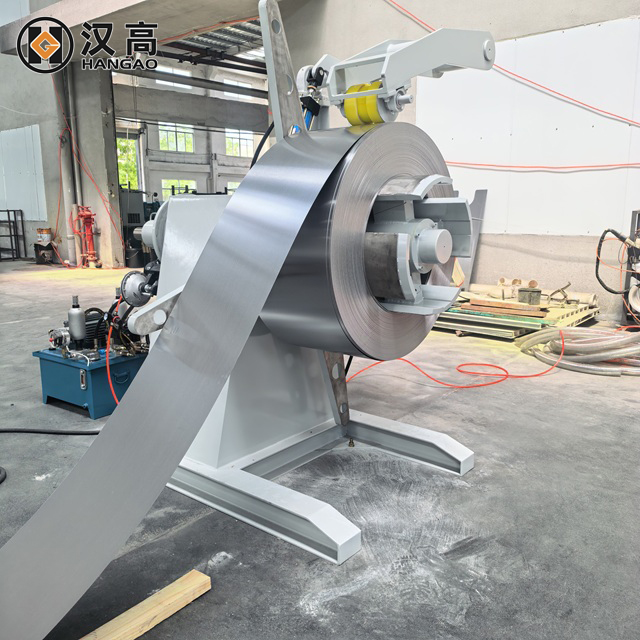
Pain Point: Which Welding Process Fits Your Production?
A conventional TIG welding tube mill remains a proven solution for stainless steel tubes, particularly when weld quality and process flexibility are priorities. However, manufacturers producing large volumes may encounter limitations in production speed and heat input. Higher heat exposure can increase the heat-affected zone and make downstream finishing or annealing more demanding.
Laser welding takes a different approach. A concentrated laser beam creates a narrow welding zone with high energy density, allowing manufacturers to achieve high production speeds while maintaining a controlled weld profile. This makes a Laser welding tube mill attractive for applications where productivity, dimensional consistency, and surface quality are critical.
The choice should also consider tube material, wall thickness, diameter range, required output, downstream annealing, and customer quality standards. There is no universal winner; the correct process depends on the production target.
Solution: Laser Welding vs. Three-Cathode TIG Welding
For high-volume stainless steel production, laser welding offers a major advantage in process concentration. Hangao's laser welded tube production line integrates forming, laser welding, weld bead rolling, sizing, bright annealing, laser cutting, and unloading into a continuous production system. The manufacturer states that the line can reach 15 m/min for 304 stainless steel tubes at 16 × 0.6 mm, with a yield rate above 98%.
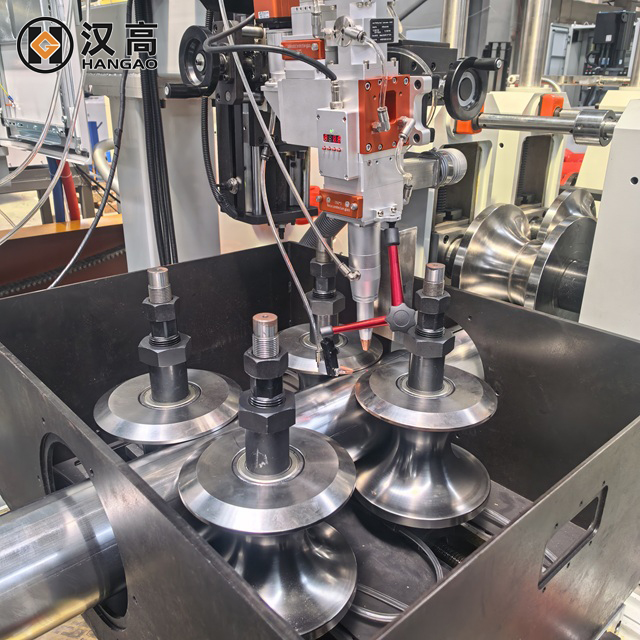
The system also emphasizes precision and traceability. Shaft runout is specified at ≤0.03 mm, while production data such as welding parameters, power, and frequency can be recorded for traceability. These features are particularly valuable for factories producing standardized industrial tubing at scale.
TIG remains highly competitive when operators require a mature and flexible welding process. Hangao's three-cathode TIG system uses three welding torches with dual electromagnetic control. The first torch helps clean oil and burrs, the second preheats the material, and the third focuses the arc for deep welding at relatively low current. According to Hangao, this arrangement helps reduce defects such as undercut and hysteresis while increasing welding speed and weld consistency.
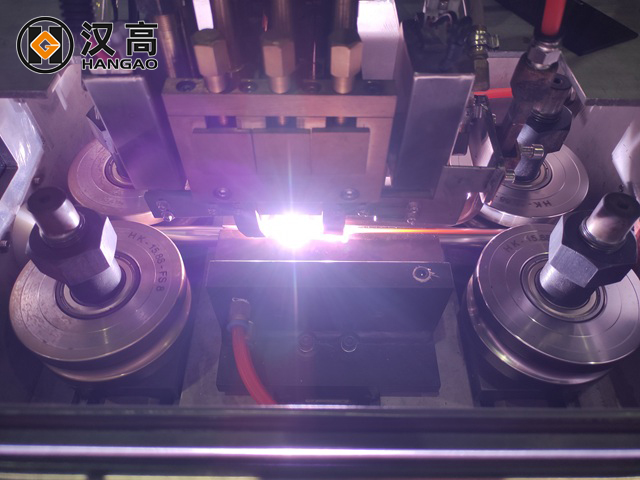
This design makes the three-cathode system different from a conventional single-TIG setup. The additional control stages improve preparation, heat distribution, and arc stability before and during welding.
Technical Parameters: What Should Buyers Compare?
When evaluating a stainless steel pipe making machine, buyers should look beyond the nominal welding speed. Five parameters deserve particular attention.
Weld penetration depth determines whether the joint can achieve the required mechanical integrity without excessive heat input. For thin-wall stainless steel, excessive penetration can create deformation or surface defects, while insufficient penetration compromises weld strength.
Heat-affected zone (HAZ) is another important factor. Laser welding generally concentrates energy into a smaller area, which can help reduce thermal distortion. TIG welding introduces more distributed heat, although a properly engineered three-cathode system can improve heat control.
Production speed must be evaluated together with tube dimensions. Hangao's laser line covers stainless steel tube diameters from approximately 5 to 114 mm and wall thicknesses from 0.4 to 4.0 mm, depending on the model. Listed laser-line capacities range from 1–15 m/min.
For its three-cathode TIG equipment, Hangao lists models covering approximately 6–365 mm outside diameters, 0.4–10.0 mm wall thickness, and speeds up to 15 m/min.
Finally, buyers should assess automation and data management. Intelligent control, parameter recording, weld tracking, bright annealing, and automatic fault protection can have a greater effect on long-term operating costs than the initial welding technology itself.
Quick Comparison
| Factor | Laser Welding | Three-Cathode TIG |
| Welding speed | Very high potential | High |
| Heat input | Highly concentrated | Controlled through multi-stage welding |
| HAZ | Generally narrow | Generally wider |
| Weld quality | Excellent with precise setup | Excellent with optimized parameters |
| Automation | Highly suitable | Highly suitable |
| Initial investment | Usually higher | Usually more moderate |
| Production flexibility | Best for standardized high-volume production | Strong flexibility across applications |
For buyers researching a Laser welding vs TIG welding cost comparison for stainless steel pipes, the calculation should include energy consumption, consumables, labor, maintenance, scrap rate, production speed, and annual output—not only machine purchase price.
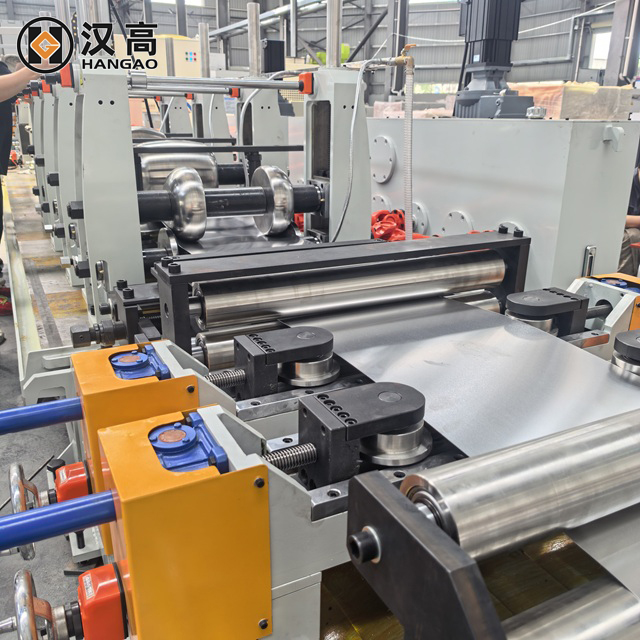
Customer Case: Selecting the Right Line for Production Goals
Consider a stainless steel tube producer supplying industrial and sanitary applications. Its existing production line uses conventional TIG welding but struggles to increase output without affecting weld consistency. In this situation, replacing the entire process blindly may not be the best solution.
If the factory mainly produces standardized thin-wall tubes in large quantities, a laser welding line can provide a stronger productivity advantage. Hangao's laser system combines welding with forming, bead rolling, sizing, bright annealing, cutting, and unloading, reducing the need to coordinate multiple independent machines.
If the factory produces a wider range of stainless steel grades and tube specifications, the three-cathode TIG solution may be more appropriate. Hangao states that its system can be applied to materials including 316L, duplex stainless steel, and nickel-based alloys, making it suitable for demanding sanitary, petrochemical, food, and automotive applications.
In other words, the best industrial stainless steel tube mill is the one matched to the factory's product mix and production economics—not simply the machine with the highest advertised speed.
5. FAQ
1.Is laser welding better than TIG welding for stainless steel tubes?
Not in every application. Laser welding is particularly attractive for high-speed, high-volume production and narrow heat input. TIG offers proven process stability and broad application flexibility. Production requirements should determine the choice.
2.Is laser welding more expensive than TIG?
The initial equipment investment can be higher. However, a laser system may reduce the cost per meter when its higher production speed, automation, yield, and reduced thermal impact are fully utilized.
3.What is the main advantage of three-cathode TIG welding?
The three-stage welding arrangement improves edge preparation, preheating, and final arc welding. Combined with electromagnetic control, it is designed to improve weld stability and reduce common defects.
4.Which process is better for thin-wall stainless steel tubes?
Laser welding is often advantageous when high speed, precise heat input, and a narrow HAZ are important. However, optimized TIG can also produce high-quality thin-wall tubes, particularly when the production line uses multi-cathode welding and accurate process control.
5.How should I choose between a laser and TIG tube mill?
Start with your tube diameter, wall thickness, stainless steel grades, target speed, annual production volume, weld quality requirements, downstream annealing process, and budget. Then compare the complete production line rather than the welding unit alone.
