

I. Introduction to Welded Pipe Production
Industrial welded steel pipes are core materials in sanitary applications, heat exchangers, petrochemicals, nuclear power, semiconductors, refrigeration, and other industrial
fields, making them an indispensable basic product in modern manufacturing. Since the 1930s, with the rapid development of high-quality strip continuous rolling technology
and advancements in welding and testing technologies, weld quality has continuously improved, and the types and specifications of welded steel pipes have become
increasingly diverse, gradually replacing seamless steel pipes in more and more fields.
Welded steel pipe production processes are simple, efficient, and offer a wide variety of types and specifications, making them widely used in low- and medium-pressure
industrial applications.
II. What is a Welded Pipeline Production Line?
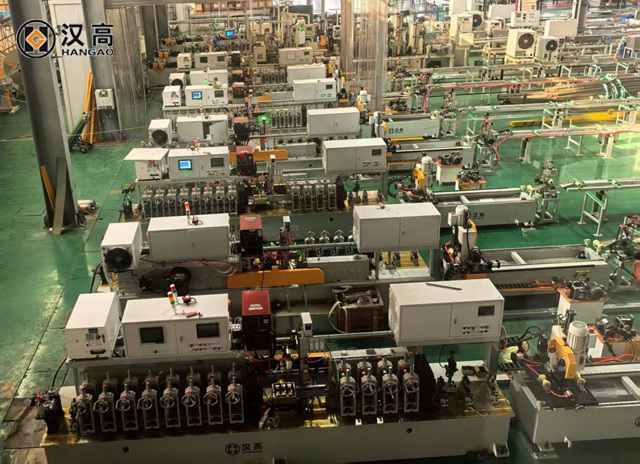
An industrial welded pipe production line typically refers to a continuous production system that includes uncoiling, storage, forming, welding, leveling, grinding, initial sizing,
heat treatment, sizing, eddy current testing, diameter measurement, cutting, end finishing, and airtightness testing. Its core objective is to bend steel strip, stainless steel strip,
or other metal strip into a tubular shape using a continuous roll forming process, then fuse the joints using technologies such as TIG welding and laser welding, and finally
sizing and cutting it into standard industrial welded pipes.
These production lines offer advantages such as high production efficiency, good dimensional accuracy, and high material utilization. The configuration and process parameters
of the production line will be adjusted accordingly based on the product specifications, diameter, wall thickness, material, and applicable standards.
III. Market Demand and Industrial Applications
Welded steel pipes are the "blood vessels" of infrastructure and industrial manufacturing. Their market demand is closely related to the development of the macroeconomy,
particularly in the sanitary, heat exchange, petrochemical, nuclear power, semiconductor, and refrigeration industries.
Oil and Gas Transportation: Laser welding is used for long-distance pipelines, requiring extremely high toughness, pressure resistance, and corrosion resistance in the
pipe material.
Machinery Manufacturing and Automotive Industry: Used in hydraulic cylinders, drive shafts, exhaust pipes, etc., where strict requirements are placed on dimensional accuracy
and surface quality.
With increasing global emphasis on energy security and green manufacturing upgrades, the demand for high-strength, lightweight, and corrosion-resistant high-performance
welded pipes continues to grow, driving production lines towards smarter and more environmentally friendly designs.
IV. Types of Welded Pipe Manufacturing Processes
**Double-Ring Laser Welding:** High efficiency, narrow heat-affected zone, widely used for straight seam welded pipes.
**Plasma Welding:** Deep penetration, high and stable weld quality, high production efficiency, suitable for medium and heavy plates and large-diameter straight seams.
**TIG Welding:** Clean weld seam, aesthetically pleasing shape, used for precision thin-walled welded pipes made of stainless steel and alloy steel.
V. Essential Equipment for Modern Industrial Pipe Manufacturing Plants
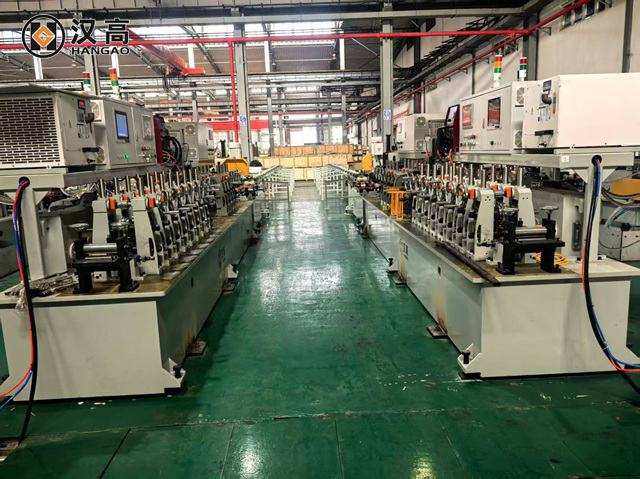
Core Production Equipment
1. Uncoiler:
Uncoils the steel strip and feeds it into the strip leveling machine. Available in double-head and single-head versions, it is the front-end equipment in the argon
arc welded pipe/laser welded pipe production line.
2. Five-Roll Leveling Machine:
Levels the strip steel before the welded pipe assembly. Generally consists of an upper machine base, lower machine base, and
transmission device, with configurations including five-roll and seven-roll.
3. Shearing and Welding Machine
To ensure continuous production of the argon arc welded pipe/laser welded pipe production line, a shearing and welding machine is used to trim the irregular ends of
the front and rear strips, clamp them, and weld them together to form a continuously producing strip.
4. Storage Device
A looper storage device is installed before the shearing and welding station at the front and rear ends of the strip. This allows the storage device to continuously supply
pre-stored strip during the preparation work of feeding, uncoiling, and cutting/welding the front and rear ends, ensuring the continuous operation of the argon
arc welded pipe/laser welded pipe production line.
5. Forming Unit
The forming unit rolls the steel plate into a tubular shape using multiple sets of rollers. The design and processing quality of the die system directly affect the shape, size,
and wall thickness uniformity of the welded pipe. The die system, welding system, and straightening device in the forming machine are the three core components
ensuring the accuracy of the welded pipe.
6. Argon Arc Welding/Laser Welding Equipment
The welding system is the heart of the stainless steel welded pipe machine, responsible for heating the strip and welding it. The accuracy of temperature control,
pressure control, and welding speed in a welding system are all crucial to weld quality.
7. Weld Leveling Equipment:
This specialized equipment flattens the weld seam of the welded pipe online. A pair of rollers repeatedly press down any protrusions in the
inner and outer weld seams, eliminating bulges and ensuring a smooth transition between the weld seam and the base material.
8. Sizing Unit:
Typically composed of several driven horizontal frames, a passive vertical roller frame, and a straightening device, this unit ultimately ensures the accuracy of
the steel pipe's outer diameter and cross-sectional shape. It also improves the formation and reduces stress concentration and residual stress generated during
TIG/laser welding.
9. Heat Treatment Equipment:
This equipment performs bright solution heat treatment on the pipe, ensuring the weld's metallographic structure and mechanical properties
are consistent with the base material, thereby eliminating welding stress and improving weld performance.
10. Straightening Machine:
This machine performs final straightening of the steel pipe, ensuring straightness meets standard requirements.
11. Fixed-Length Flying Saw:
This machine enables high-precision fixed-length cutting of TIG/laser welded pipes while they are operating online. Cutting methods include
sawing, rotary cutting, and punching.
VI. Factors Affecting Production Line Efficiency
Optimizing production line efficiency is key to enhancing competitiveness. The main influencing factors include:
Equipment Performance and Stability: The precision and durability of the tube forming machine, forming rollers, and welding heads, as well as the reliability of the
transmission system, directly determine downtime and product yield.
Process Parameter Optimization: Matching welding power, speed, and extrusion pressure, and the die design of the forming rollers, require precise adjustments
based on materials and specifications.
Production Planning and Die Changeover Time: Changing between different product specifications requires replacing the entire set of forming rollers and sizing rollers.
Shortening die changeover time is crucial for improving flexible production capabilities.
Raw Material Quality: The chemical composition, mechanical properties, thickness tolerances, and edge quality of the strip steel must be stable; otherwise, welding defects or
forming problems are likely to occur.
Automation and Intelligence Level: Online inspection systems (such as eddy current and ultrasonic testing), real-time process monitoring, and adaptive control systems can
significantly reduce scrap and enable predictive maintenance.
Personnel Skills: The understanding of the process and troubleshooting capabilities of operators and maintenance personnel are crucial.
VII. Future Trends in Pipeline Manufacturing
Welded pipe production is evolving towards greater intelligence, green practices, and higher efficiency. In the future, production lines based on the Internet of Things (IoT)
and AI will achieve full-process data visualization and process self-optimization, building "digital twin" factories. Modular design and technologies such as laser welding
will enhance production line flexibility, supporting efficient small-batch, multi-specification production. To meet extreme demands such as deep-sea applications and
hydrogen energy, production lines will be adapted to high-end materials such as high-strength steel and corrosion-resistant alloys. Green manufacturing will
permeate the entire process, from energy conservation and emission reduction to carbon footprint management, becoming an industry standard. Investing in advanced
processes, intelligent equipment, and digital transformation is key for enterprises to maintain competitiveness and achieve high-quality development.
