



If Our Product Is What You Want
Please get in touch with our team immediately to answer you with a more professional solution


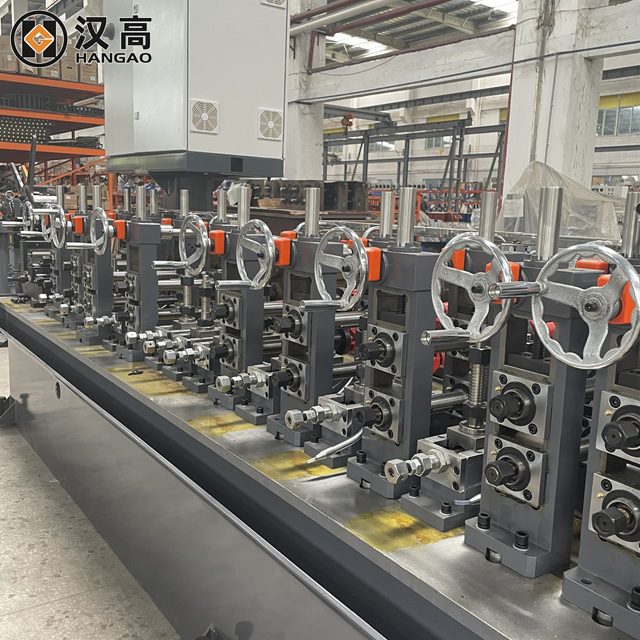
Whole line layout

Whole line layout
| Type | Material | Welding type | O.D. (mm) | Thickness (mm) | Motor Power (KW) | Size(L*W*H)(m) |
| HZG-HR-30 | SST | TIG | 6-16 | 0.4-1.5 | 5.5 | Customized |
| HZG-HR-40 | SST | TIG | 16-50.8 | 0.5-2.5 | 7.5 | Customized |
| HZG-HR-50 | SST | TIG | 25.4-76 | 0.5-3.0 | 11 | Customized |
| HZG-HR-60 | SST | TIG/Plasma | 50.8-114 | 1.0-4.0 | 15 | Customized |
| HZG-HR-80 | SST | TIG/Plasma | 89-168 | 1.0-5.0 | 18.5 | Customized |
| HZG-HR-100 | SST | TIG/Plasma | 114-219 | 2.0-8.0 | 30 | Customized |
| HZG-HR-120 | SST | TIG/Plasma | 168-325 | 3.0-10.0 | 37 | Customized |
Versatile Production:
The company’s production line is so flexible that it can change from one pipe type to another made of different materials (304, 316L, duplex stainless steel, etc.), specifications, and shapes in response to the market demand for small batches and multiple varieties.
Material Adaptability:
Compatible with various heat exchanger tube materials, such as stainless steel, thus being suitable for a range of operating conditions and media.
High Precision Forming:
It uses a combination of precision welding, cold working, heat treatment, and surface forming technologies to achieve industrial-quality products that can conform to the rigorous ASTM/ASME as well as GB standards.
Automated Control System:
The production line as a whole runs under the control of an integrated PLC/MES system, which enables "one-button" manufacturing of finished products from raw materials, alongside the automatic adjustment of process parameters and the acquisition and traceability of data in real-time.
Quick Adjustment and Switching:
Designed to be highly versatile, allowing rGas & Oil adjustment and changing between various specifications or heat exchanger tube shapes to meet the fluctuations in market demand.
Energy-efficient and Environmentally Friendly:
Uses top-notch production technology with energy-saving and environmentally friendly features, thus being in line with the green production concept.
User-Friendly Operation and Maintenance:
Simple structural design with a user-friendly interface for easy operation, together with the maintenance functions that are convenient and help to keep the equipment stable for a long time.
Compliance with Quality Standards:
Make sure that the heat exchanger tubes that are produced conform to the quality standards and the certification requirements, so that the end product is reliable and safe.
| Condition | New |
| Theory | Inverter |
| Application | Industry |
| Type | Heat Exchanger Pipe Production Line |
| Scope of Application | Heat Exchanger Pipe |
| O.D. Range | 6-325 mm |
| Thickness | 0.38-10.0 |
| Control Type | PLC |
| Certification | ISO9001 |
| Power(W) | 0 |
| Voltage | 380V 50Hz |
| Power Supply | 415V/3pH |
| Dimension(L*W*H) | Customized |
| Weight | 5-15t |
| Lead Time | 60-90 Days |
| Transport Package | Waterproof Film and Pallets |
| Production Capacity | 20 Sets Per Year, 1-15 M/Min |
| Package Size | Customized |
| Package Gross Weight | 25000.000kg |
Project Details
Established: 2020
Core Expertise: 20+ years of background in welded pipe equipment.
Factory Size: More than 20,000 square meters of modern production base and warehouse.
Core Products: Precision-welded pipe production lines, welding leveling equipment, bright solution equipment, weld seam tracking systems, intelligent control systems, finishing rolling pipe bright solution equipment, rotary annealing equipment, etc.
FAQ
Q1: How can I produce high-precision stainless steel heat exchanger tubes?
A1: High-precision heat exchanger tubes require accurate strip thickness, forming, welding, sizing, and annealing control, combined with reliable inspection. Hangao provides heat exchanger tube production lines integrating welding, sizing, annealing, and inspection systems.
Q2: How can I improve weld consistency in stainless steel tube production?
A2: Weld consistency depends on strip-edge condition, forming accuracy, welding current, heat input, travel speed, shielding gas, and torch alignment. Hangao's three-cathode TIG system uses sequential edge cleaning, preheating, and deep welding with electromagnetic control to improve welding stability.
Q3:Why do stainless steel tubes have uneven weld beads?
A3: Uneven weld beads can result from poor strip-edge preparation, unstable forming, welding-current fluctuations, travel-speed variation, insufficient shielding gas, or torch misalignment. The problem should be investigated across forming, welding, and process-control systems rather than adjusting welding current alone.
Q4: How can I reduce undercut defects in stainless steel tube welding?
A4: Undercut can be reduced by controlling welding current, travel speed, strip-edge gap, torch angle, and shielding gas while keeping the strip edges clean. Hangao's three-cathode TIG system uses the first torch for edge cleaning followed by preheating and deep welding, helping reduce common defects such as undercut.
Q5: How can heat input be controlled during stainless steel tube welding?
A5: Heat input can be controlled through welding current, voltage, travel speed, laser power, and multi-stage welding strategies. For precision thin-wall tubes, optimized heat input helps reduce the heat-affected zone and deformation risk.
