Tube Mill Forming Stand System
High-Precision Horizontal & Vertical Roll Forming Solution
Product Overview
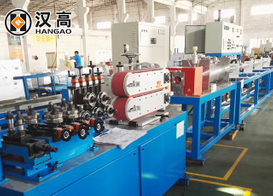
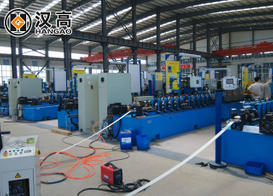
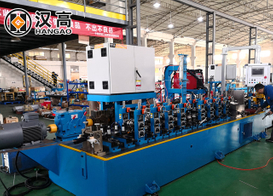
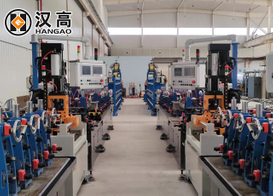
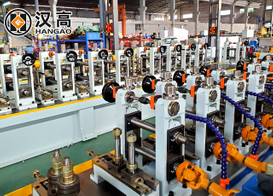
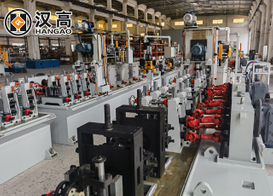
This tube mill forming stand system produces stainless steel tubes by applying step-by-step controlled deformation through alternately arranged horizontal roll stands and vertical roll stands.
The system is designed to manufacture stainless steel tubes in different sizes with high dimensional consistency and stable forming quality.
Entry Section
Before the strip enters the forming stands, a dedicated entry system is installed to improve forming stability and welding quality.
Integrated strip deburring unit at the tube mill entry
Guide rollers installed on both sides to stabilize strip feeding
A cutting tool positioned between the guide rollers to trim strip edge burrs
Felt cleaning pads installed above and below the strip to remove oil and surface contamination
This entry design effectively reduces edge defects and ensures a clean, stable strip for subsequent tube forming.
Horizontal Roll Forming Stand
Structure and Function
The horizontal roll forming stand shapes the strip by roll forming with different roll grooves. It is one of the core components of the tube mill forming section.
Main components include:
Upper and lower horizontal shafts
Bearing housings for support shafts
High-rigidity machine frame
Upper shaft adjustment mechanism
The upper horizontal roll shaft can be precisely adjusted in the vertical direction to control forming pressure and the roll gap at different deformation stages, ensuring stable tube geometry.
Synchronous Lifting System
The fixed stand and movable stand are connected by a common synchronous lifting system
Smooth and synchronized lifting movement
Lifting position displayed by a digital indicator
This patented lifting system provides a repeat positioning accuracy of ±0.015 mm.
After size changeover, returning to the previous setting keeps the total deviation within 0.03 mm, significantly reducing setup time and adjustment workload in the tube mill.
Fixed Stand and Movable Stand Design
Fixed Stand
Arc-shaped reinforcing ribs to ensure high structural rigidity
Base keyway positioning
Four corner bolts lock the stand firmly to the machine table
Guarantees long-term stability during tube mill operation
Movable Stand
One-piece integrated frame design
Arc-shaped ribs for enhanced strength
Built-in lifting handle under the frame for easy removal and handling
Fixing bolts positioned directly underneath the stand, providing better force distribution and more accurate positioning compared with rear-mounted designs
Frame Material and Machining Process
Frame Material
Ductile cast iron features high yield strength and low elongation, making it more suitable than steel for forming stand structures.
Due to its excellent dimensional stability and resistance to plastic deformation, it is widely used in machine tool beds and precision tube mill frames.
Machining Process
All frames are machined in one setup on a 5-axis machining center
Eliminates positioning errors caused by multiple setups
Verticality, parallelism, and thickness tolerances are strictly controlled within drawing requirements
Vertical Roll Stand
Function
The vertical roll stand in the tube mill performs several critical functions:
Provides transition deformation between two horizontal roll stands
Suppresses tube springback after exiting the horizontal rolls
Guides the tube accurately into the next horizontal forming stand
The vertical roll assembly consists of:
The adjustment mechanism allows precise control of the distance and center position between the two vertical rolls.
Vertical Roll Stand Features
Newly patented stand structure ensuring perfect vertical alignment between the roll shaft and sliding block
Opening and closing repeat accuracy of ±0.015 mm
Vertical roll shaft material: 42CrMo, offering high strength and fatigue resistance
Vertical roll housing material: Ductile cast iron HT450, one-time casting with annealing for long-term dimensional stability
Machine Table Design
Table Structure
The tube mill table consists of three main parts:
Material Configuration
Top plate: 45# steel, 32 mm raw thickness, precision-machined to 30 mm
Side plates: 10 mm thickness
Machining and Accuracy Control
After welding, the entire machine base undergoes stress-relief annealing
Milling, drilling, and keyway machining are completed in one setup
Final surface grinding ensures flatness accuracy
The table flatness is controlled within <0.02 mm, providing a stable and accurate installation reference for tube mill forming stands and ensuring long-term operational stability.