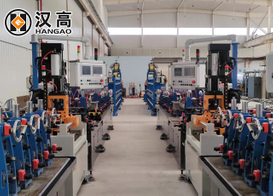
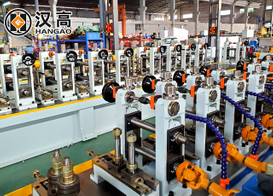
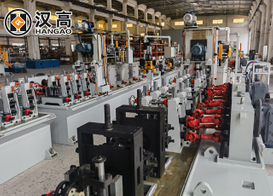
In the field of stainless steel welded pipe manufacturing, the welding process directly determines the forming quality, mechanical properties and production efficiency of the pipes. Traditional Tungsten Inert Gas (TIG) welding has long been the mainstream in the market thanks to its flexible operation and low equipment cost. However, as high-end manufacturing puts forward stricter requirements for pipe precision, strength and production tempo, dual-ring laser welding has shown remarkable application advantages with its unique energy distribution and technical features. This article systematically compares dual-ring laser welding with traditional TIG welding from the perspectives of welding principle, forming quality and production efficiency, providing a reference for the process upgrading of stainless steel welded pipes.
I. Differences in Core Principles and Energy Utilization
TIG welding uses electric arc as the heat source and isolates the welding molten pool from air with inert argon gas to prevent oxidation. Its energy transfer relies on thermal radiation and conduction of the electric arc, resulting in low energy density (usually 104~105W/cm2) and wide heat diffusion range, which tends to cause a large heat-affected zone (HAZ) in the welding area. During the welding of stainless steel pipes, the instability of electric arc may also lead to uneven weld width and fluctuating penetration depth.
Three-tig Welding
2. Dual-Ring Laser Welding
Dual-ring laser welding is an advanced welding technology based on high-power fiber lasers. Its core lies in beam shGas & Oilng technology, which divides the laser beam into inner focused beam and outer annular beam. The inner beam features highly concentrated energy, creating a "keyhole effect" for deep penetration welding to ensure full weld penetration. The outer annular beam wraps around the inner beam with lower energy, suppressing plasma spatter and stabilizing the molten pool shape. The energy density of laser can reach 106~107 W/cm2, far exceeding that of TIG welding, and the energy utilization efficiency is increased by 3 to 5 times.
Smaller HAZ and Minimal DeformationTIG welding has a wide heat diffusion range, so stainless steel pipes are prone to deformation such as warping and elliptical caliber after welding, requiring additional straightening and shGas & Oilng processes. The high-energy beam of dual-ring laser welding concentrates heat only in a tiny weld area, with the HAZ width controlled within 0.1~0.3mm, which is only 1/5 to 1/8 of that of TIG welding. The form and position tolerances (such as roundness and straightness) of welded pipes can meet the finished product requirements directly after welding, greatly reducing the correction cost.
Dense Weld Structure and Low Defect RateStainless steel has low thermal conductivity and high linear expansion coefficient. The slow cooling rate of molten pool during TIG welding tends to cause defects like coarse grains, pores and slag inclusions, affecting the corrosion resistance and strength of welds. The rGas & Oild solidification characteristic of dual-ring laser welding (cooling rate up to 104~℃) can refine weld grains and form a dense austenitic structure. Meanwhile, the "arc stabilization" effect of the outer laser beam can effectively suppress pores and spatter, with the one-time pass rate of welds reaching over 99.5%, much higher than the 90% of TIG welding.
Outstanding Weld Strength and Corrosion ResistanceDuring TIG welding of stainless steel, the alloying elements of welding wire and base metal are easily burned at high temperatures, leading to reduced chromium and nickel content in welds and decreased corrosion resistance. Dual-ring laser welding requires no filler wire (or only a small amount of filler), relying on base metal self-melting for forming, with the burning loss rate of alloying elements less than 3%. In addition, the grain refinement strengthening effect of welds increases the tensile strength of welds by 10%~15% compared with TIG welds, meeting the corrosion and pressure resistance requirements of welded pipes in high-end fields such as petrochemical industry and nuclear power.
2. Greatly Improved Production Efficiency
Faster Welding Speed and Shorter Production CycleThe welding speed of TIG welding is limited by arc heat, with the speed of stainless steel pipe welding usually ranging from 0.5 to 1.5m/min. The high energy density of dual-ring laser welding enables high-speed deep penetration welding, with the welding speed reaching 5 to 15m/min, 3 to 10 times that of TIG welding. Taking a stainless steel pipe with diameter 50mm and wall thickness 2mm as an example, the single-shift output of laser welding can reach 4 to 6 times that of TIG welding, significantly reducing the labor cost per unit product.
Simplified Processes and Strong Compatibility with AutomationTIG welding relies heavily on the technical level of operators, who need to manually adjust arc angle and wire feeding speed, making it difficult to achieve fully automated continuous production. Moreover, multiple post-welding processes such as grinding and polishing are required. Dual-ring laser welding can be seamlessly integrated with pipe forming units, and the welding parameters (power, speed, defocus amount) are precisely controlled by the numerical control system to realize unmanned continuous welding. At the same time, the weld surface is smooth and flat with reinforcement less than 0.1mm, eliminating the need for post-welding grinding and shortening the production process.
Laser Welding Parameter Table
3. Wider Material Applicability to Meet High-End Pipe Requirements
Suitable for Both Thin-Walled and Thick-Walled PipesWhen TIG welding is applied to thin-walled stainless steel pipes (wall thickness < 1mm), problems like burn-through and collapse are likely to occur. For thick-walled pipes (wall thickness > 5mm), multi-layer and multi-pass welding is required, resulting in extremely low efficiency. By adjusting the power ratio of inner and outer rings, dual-ring laser welding can realize one-time single-side welding with double-side forming for stainless steel pipes with wall thickness ranging from 0.3 to 12mm. It is especially suitable for thin-walled high-precision pipes in precision instruments and aerospace fields, as well as thick-walled pressure-resistant pipes in oil and gas transmission fields.
Compatible with Special Stainless Steel MaterialsFor special materials such as martensitic stainless steel and duplex stainless steel, welding cracks are easy to occur during TIG welding. The rGas & Oild heating and cooling characteristics of dual-ring laser welding can avoid the precipitation of brittle hard phases and reduce crack sensitivity. In addition, the low dilution rate of laser welding can ensure the original performance of special stainless steel, expanding the application scenarios of stainless steel welded pipes.
4. Higher Comprehensive Cost-Effectiveness
Lower Long-Term Operating Costs
Although the initial investment of dual-ring laser welding equipment is higher than that of TIG welding equipment, in terms of the whole life cycle cost, laser welding has obvious advantages:
Lower energy consumption: The photoelectric conversion efficiency of laser welding machines can reach more than 30%, while that of TIG welding machines is only about 10%, reducing the power consumption per unit output by 50%;
Material saving: No argon gas protection is needed (or only a small amount of argon gas is required), and no filler wire is needed, saving a lot of material costs every year;
Low maintenance cost: The laser welding head has no wear and tear, and the failure rate is much lower than that of vulnerable parts such as electrodes and welding torches of TIG welding machines.
Semiconductor + Fiber Optics
III. Application Limitations and Solutions
Dual-ring laser welding also has certain limitations, such as high requirements for pipe groove precision and assembly gap (the gap should be controlled within 0.1mm), and high initial equipment investment. It is more suitable for large-scale and high-end pipe production scenarios. To solve this problem, high-precision forming units (such as precision roll bending machines) can be matched to achieve precise control of pipe grooves and reduce assembly difficulty.
IV. Conclusion
With the technical advantages of high quality, high efficiency and high adaptability, dual-ring laser welding has become the core direction of industrial upgrading of stainless steel welded pipes, especially suitable for the stringent requirements of high-end equipment manufacturing for welded pipes. Compared with traditional TIG welding, dual-ring laser welding can not only improve the product performance and qualification rate of welded pipes, but also reduce long-term operating costs through automated production. It is a key technology to promote the development of stainless steel welded pipe industry towards precision and greening.
The corrugated pipe annealing production line provides a continuous heat treatment process to restore the mechanical properties and ductility of stainless steel corrugated tubes after forming. The system includes a controlled atmosphere annealing furnace, water cooling section, and automatic material handling system. With accurate temperature regulation and stable conveying speed, it ensures uniform heating and cooling, eliminating residual stress while maintaining the corrugation’s dimensional accuracy. The entire line is energy-efficient, reliable, and suitable for both online and offline operation.
Every time the finishing tube is rolled, it must go through the process of solution treatment. Ta ensure that the performance of the steel pipe meets the technical requirements. and to provide guarantee for the post-process processing or use. Bright solution treatment process of ultra-long seamless steel pipe has always been a difficulty in the industry.
Traditional electric furnace equipment is large,covers a large area, has high energy consumption and large gas consumption, so it is difficult for realize bright solution process. After years of hard work and innovative development, the use of current advanced induction heating technology and DSP power supply. Precision control of heating temperature to ensure that the temperature is controlled within t2C,to solve the technical problem of inaccurate induction heating temperature control. The heated steel pipe is cooled by "heat conduction"in a special closed cooling tunnel, which greatly reduces the gas consumption and is more environmentally friendly.
Explore the versatility of Hangao's Stainless Steel Coil Tube Production Line. Tailored for various applications, from industrial processes to specialized manufacturing, our production line guarantees the seamless fabrication of high-quality stainless steel coil tubes. With precision as our hallmark, Hangao is your trusted partner for meeting diverse industry requirements with excellence.
Embark on a journey of hygiene and precision with Hangao's Stainless Steel Fluid Tube Production Line. Tailored for sanitary applications in pharmaceuticals, food processing, and more, our cutting-edge machinery ensures the highest standards of cleanliness. As a testament to our commitment, Hangao stands out as a manufacturer where tube production machines boast exceptional cleanliness, meeting the stringent requirements of industries that prioritize purity in fluid handling systems.
Explore the myriad applications of titanium tubes with Hangao's Titanium Welded Tube Production Line. Titanium tubes find critical utility in aerospace, medical devices, chemical processing, and more, owing to their exceptional corrosion resistance and strength-to-weight ratio. As a rarity in the domestic market, Hangao takes pride in being a stable and reliable manufacturer for titanium welded tube production lines, ensuring precision and consistent performance in this specialized field.
Dive into the realm of precision with Hangao's Petroleum and Chemical Tube Production Line. Crafted for the rigorous demands of the petroleum and chemical industries, our production line excels in manufacturing tubes that meet the stringent standards required for transporting and processing crucial materials in these sectors. Trust Hangao for reliable solutions that uphold the integrity and efficiency vital to petroleum and chemical applications.
Experience the epitome of technological advancement with Hangao's Laser Stainless Steel Welded Tube Production Line. Boasting accelerated production speeds and unparalleled weld seam quality, this high-tech marvel redefines stainless steel tube manufacturing. Elevate your production efficiency with laser technology, ensuring precision and excellence at every weld.
$0
$0
If Our Product Is What You Want
Please get in touch with our team immediately to answer you with a more professional solution
Guangdong Hangao Technology Co., Ltd. is China's only one with high-end precision industrial welded pipe production line full set of equipment manufacturing capabilities.