I. Introduction: Weld Quality is the Lifeline of the Pipe Manufacturing Industry
In the metal pipe manufacturing sector, forming and welding are core processes, and weld quality is the key factor that determines product performance. Whether it's industrial stainless steel pipes, refrigeration pipes, air conditioning connecting pipes, or high-demand heat exchanger pipes and fluid pipes, the reliability of welds directly impacts the product's pressure resistance, corrosion resistance, fatigue life, and overall safety.
However, weld quality can't be judged just by its appearance. What truly defines weld performance is the metallographic structure inside the weld.
As laser welding technology becomes more widespread, research on weld metallography has grown increasingly important. It not only reflects the technical level of the production line but also gives an accurate picture of product lifespan and stability in high-pressure environments. For this reason, more and more customers are paying attention to weld metallographic structure when choosing pipe manufacturing equipment, not just focusing on speed or power.
II. What is Weld Metallography? Why Does It Determine Product Quality?
1. Definition of Metallographic Structure
Metallography is the science of studying the internal microstructure of metals. By using a microscope, we can observe structures in the weld cross-section such as grains, fusion lines, weld penetration, and heat-affected zones (HAZ).
It can accurately show what happens during the welding process:
Is the melting depth sufficient?
Is the metal fully fused?
Are there any cracks, pores, or inclusions?
Are the grains coarse or uneven?
Is the heat-affected zone too wide?
Is the weld structure stable?
With this information, we can tell if the welding quality meets the required standards.
Weld Seam
2. How Weld Metallography Affects Product Performance
Performance Indicator
Key Factors Determined by Metallographic Structure
Pressure Resistance
Weld depth, fusion quality, grain uniformity
Corrosion Resistance
Grain density, presence of inclusions
Fatigue Life
Metallographic continuity, presence of microcracks
Air Tightness
Presence of weld holes, incomplete penetration
Weld Strength
Quality of metallurgical bonding
In other words: The more uniform and dense the weld metallography, the more stable the product. The more defects there are, the less reliable the product becomes. That's why metallographic testing has become one of the core quality standards in the pipe manufacturing industry.
III. Comparing Weld Metallography Across Manufacturers: Why Are the Differences So Clear?
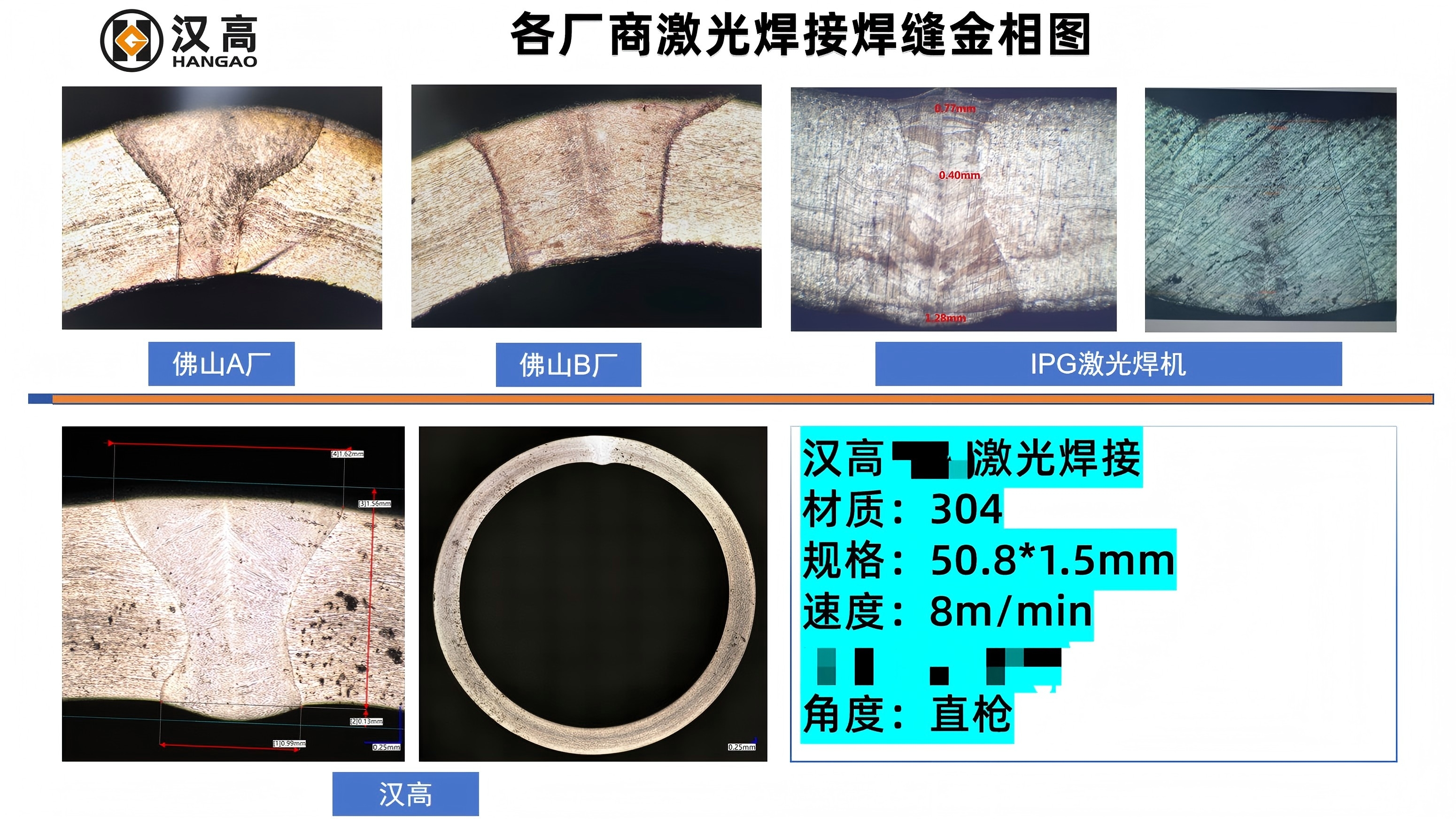
1. Significant Differences in Weld Depth
Some manufacturers have shallow weld depth → risk of incomplete penetration
Some have overly wide weld pools → too much heat input, making welds prone to deformation
Hangao's welds have consistent depth, showing a uniform "hourglass" structure
2. Variations in Grain Structure Quality
Coarse grains → lower strength and easier corrosion
Irregular structure → unstable welding process
Many inclusions → unstable wire feeding or poor energy control
Hangao's welds have fine, uniform grains, showing precise control of energy input
3. Differences in Fusion Lines (Transition Zone Between Weld and Base Metal)
Some samples have an obvious "step-like transition" → energy is too concentrated, leading to incomplete fusion
Others show burn-through marks → unstable energy control
Hangao's fusion lines are smooth and natural, a typical feature of high-performance welding
Weld Metallography Across Manufacturers
Summary:
The differences in weld metallography come from a combination of factors such as forming precision, strip feeding accuracy, laser energy control, cooling speed, and process stability.
Hangao's excellent metallographic performance shows that its overall process system is among the best in the industry.
IV. Application Value in Condenser, Refrigeration, and Industrial Pipe Sectors
Excellent weld metallography brings significant benefits to the industry:
Higher pressure resistance
Lower leakage rate
Better corrosion resistance
Smaller weld shadows (for decorative pipes)
Longer fatigue life
This is especially important in the air conditioning industry, which uses high-pressure eco-friendly refrigerants like R32 and R290 — where weld reliability is critical.
V. The Successful TUBOTECH 2025
The 2025 TUBOTECH exhibition in Brazil was a great success, attracted relevant colleagues to engage in communication.
TUBOTECH EXHIBITION
VI. Conclusion: Weld Metallography is the True Core of Enterprise Competitiveness
Metallographic structure is the most authentic reflection of weld quality. No matter how perfect the appearance is, only excellent metallography can ensure the product is truly safe and reliable in use. Through extensive practice, laboratory testing, and customer feedback, Hangao has verified the advantages of laser welding in terms of stability, performance, and consistency.
Weld metallography is not just a technical standard — it's also a measure of a company's brand strength.
Hangao will continue to provide high-quality welding equipment solutions to global customers with more advanced welding technology, stricter metallographic standards, and more intelligent manufacturing capabilities.
Guangdong Hangao Technology Co., Ltd. is China's only one with high-end precision industrial welded pipe production line full set of equipment manufacturing capabilities.