From the heat exchangers in petrochemical refineries to the hydraulic lines inside earth-moving equipment, metal tubes quietly carry the fluids and gases that keep industrial supply chains alive. Yet many procurement managers specify tube based only on alloy grade and outer diameter, unaware that the manufacturing route—seamless, welded, or cold-drawn—determines wall tolerance, concentricity, surface finish, and ultimately the cost of every subsequent bending, welding, or finishing operation. With raw material now accounting for up to 70 % of total tube price, understanding how tubes are made is no longer a metallurgy curiosity; it is a lever for negotiating better contracts and avoiding costly field failures.
This article walks through every major production pathway used by global mills, quantifies the tolerances and mechanical properties that each method can hold, and finishes with a decision matrix that lets buyers match process to application without overpaying for capability they will never use.
Tubes are manufactured by either hot rotary piercing of solid billets to produce seamless product, or by continuous forming and welding of coiled strip to produce welded product, followed—when higher dimensional accuracy is needed—by cold drawing or cold pilgering to reduce diameter and wall thickness while improving surface finish and mechanical properties.
Although the sentence above captures the essence, the real value for a commercial user lies in understanding how each subprocess—casting, reheating, piercing, elongating, welding, sizing, heat treating, and finishing—interacts with alloy chemistry, energy input, and inspection technology to create the property set that ASTM, EN, or JIS specifications ultimately certify. The following sections therefore deconstruct the process, quantify critical parameters, and compare performance data so that decision-makers can match tube route to service conditions rather than to commodity availability.
Because every supply-chain manager ultimately asks “How do I get the mechanical properties I need at the lowest total cost per meter?” the article concludes with a specification checklist, a cost-per-property table, and a risk matrix that can be dropped straight into a purchase dossier or MRO handbook.
Raw Material Preparation: From Melt to Hollow Bloom
Tube making begins with an electric arc furnace melt refined to low inclusion content, then cast into round billets 150–400 mm diameter by electromagnetic or soft reduction continuous casting to ensure internal soundness before rotary piercing converts the solid billet into a hollow bloom at 1200 °C.
The first quality gate is melt chemistry. For low-carbon tube grades, sulfur below 0.010 % and phosphorous below 0.015 % reduce ductile-dip cracking during subsequent cold work; for 9 % Cr heat-resistant grades, tight carbon ±0.02 % windows prevent delta ferrite stringers that would drop creep life 30 %. Vacuum degassing to 1 mbar lowers hydrogen to 1 ppm, eliminating fish-scale delamination during high-pressure hydrotesting.
Continuous casting parameters set the limit for seamless tube concentricity. Soft reduction at 0.5 mm m⁻⊃1; in the final two metallurgical lengths compensates centerline solidification shrinkage, reducing the macro-segregation index from 0.22 to 0.08 as measured by sulfur prints. The resulting billet ultrasonic rejection rate falls from 4 % to 1 %, saving USD 35 t⁻⊃1; in re-melt costs.
Surface conditioning before piercing is equally critical. A 0.8 mm deep turning pass removes oscillation marks that would otherwise fold into the tube wall and create lamination defects detectable only after final heat treatment. Although turning adds USD 12 t⁻⊃1;, it prevents 0.5 % field scrap in high-pressure boiler applications where lamination can trigger catastrophic rupture.
Seamless Tube Routes: Rotary Piercing, Elongating, and Sizing
Seamless tube is produced by cross-rolling the heated billet between two barrel-shaped rolls and a plug to create a hollow bloom, then elongating the bloom on a mandrel mill or pilger stand to reduce wall thickness 80 % while maintaining concentricity within ±5 %, followed by three-stand sizing mills that bring outer diameter to final tolerance ±0.5 %.
The Mannesmann piercing mill generates 60 % circumferential elongation in 3 s, imposing a strain rate of 30 s⁻⊃1;. Finite-element models show that plug nose temperature must stay above 1050 °C to avoid martensitic transformation in CrMo steels; otherwise, a 200 HV hard spot forms that causes plug cracking and shortens tool life from 400 to 120 blooms. Integrated pyrometers now adjust induction reheat power every 200 ms, keeping plug temperature within ±15 °C and extending tool life 35 %.
On the mandrel mill, the key parameter is retained mandrel speed. Running at 1.4 m s⁻⊃1; instead of 1.0 m s⁻⊃1; increases throughput 40 % but also raises ovality from 0.6 % to 1.1 %. Mills targeting Gas & Oil 5CT PSL-2 therefore cap speed at 1.2 m s⁻⊃1;, accepting lower tonnage to guarantee ovality ≤0.8 % that customers need for automatic thread rolling.
Pilgering delivers the thinnest walls—down to 2 mm on 250 mm OD—because the 180° back-and-forth motion imposes 85 % wall reduction per pass while the mandrel supports the ID. The trade-off is length: each cycle advances the tube only 15 mm, so a 12 m mother hollow needs 800 strokes over 20 min. Although slow, pilgering achieves 0.3 % ovality and 1 µm Ra inner surface, eliminating the need for inner surface grinding in ultra-high-purity semiconductor tubing.
Welded Tube Pathways: ERW, HFI, and Laser Welding Compared
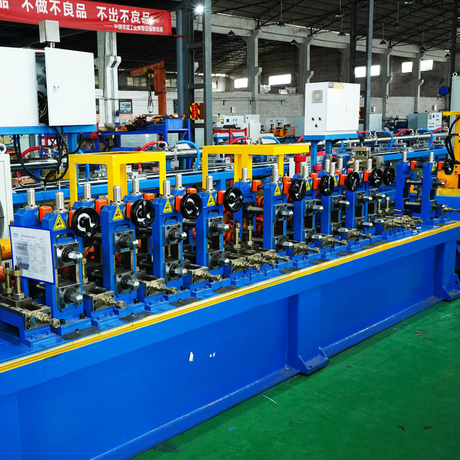
Electric resistance welded tube is made by cold forming coiled strip through a series of breakdown, fin, and sizing passes, then fusing the abutting edges at 1400 °C by applying 100 kHz current and forge pressure 50 MPa to produce a narrow heat-affected zone 0.5 mm wide, followed by in-line seam annealing and full-body normalizing when specified.
High-frequency induction welding dominates OD 10–610 mm because it localizes heat at the vee apex, keeping total energy input 30 % lower than contact welding. Power density of 1.2 kW mm⁻⊃2; melts the edges in 0.1 s, limiting grain growth in the HAZ to 2 ASTM numbers compared with 4 numbers in submerged arc welding. The result is weld hardness 180 HV versus 240 HV in SAW, reducing the risk of sulfide stress cracking in sour service.
Recent laser welding lines push frequency to 10 kHz and beam width to 0.2 mm, enabling wall thickness up to 20 mm at travel speeds of 10 m min⁻⊃1;. Keyhole depth is controlled by plasma suppression gas (helium 30 L min⁻⊃1;) that stabilizes the molten pool and prevents undercut. Mechanical testing shows Charpy V-notch impact toughness 60 J at 40 °C, matching seamless performance in pipeline grades up to X70.
Post-weld heat treatment choices depend on service. For structural hollow sections, simply cooling under 50 °C s⁻⊃1; produces ferrite plus pearlite with yield strength 355 MPa. For boiler tube, in-line seam normalizing at 920 °C for 30 s dissolves chromium carbides, restoring 20 % creep rupture life that would otherwise be lost in the coarse-grained HAZ. Energy cost is 18 kWh t⁻⊃1;, adding USD 9 t⁻⊃1; but allowing mills to certify 100 000 h creep life at 540 °C.
Cold Drawing and Cold Pilgering for Precision Dimensions
To achieve OD tolerance ±0.1 mm and wall tolerance ±0.05 mm, welded or seamless mother tube is pickled, lubricated with zinc phosphate plus soap, then cold drawn through a tungsten carbide die with a floating plug to reduce cross section 25 % per pass, or cold pilgered with 180° reciprocating dies to impose 70 % wall reduction while maintaining internal mandrel support for ultra-thin walls.
Cold drawing work-hardens the steel, raising yield strength 30 % but reducing elongation 15 %. For hydraulic line tube requiring 550 MPa yield yet ≥15 % elongation, mills interpass anneal at 650 °C for 20 min in a nitrogen atmosphere to recrystallize ferrite grains to 15 µm while preventing decarburization that would drop fatigue life 25 %.
Pilgering achieves the tightest concentricity because the mandrel supports the ID during the entire 360° circumference. On 316L stainless, a two-pass pilger cycle reduces ovality from 0.9 % to 0.15 % and wall variation from ±8 % to ±2 %. The penalty is surface roughness 2 µm Ra on the OD, requiring a final 0.05 mm skin-pass grinding step for semiconductor gas lines that demand 0.4 µm Ra.
Bundle drawing—pulling 50 tubes simultaneously through a single die—cuts drawing cost 60 % but limits OD ≥20 mm and wall ≥2 mm. Uniformity across the bundle is maintained by hydraulic actuators that adjust plug position every 3 s based on laser micrometer feedback, keeping within ±0.03 mm wall for 98 % of the bundle.
Heat Treatment and Microstructure Control
After forming, tubes are austenitized at 900 °C for 1 min per mm wall, then water quenched to produce martensite in alloy grades, followed by tempering at 600–700 °C to precipitate carbides and achieve 22 HRC hardness that meets NACE MR0175 sour-service limits while retaining 550 MPa yield strength.
For 9Cr-1Mo-V power plant tubing, normalizing at 1050 °C followed by 750 °C tempering creates a fully tempered martensite matrix with M23C6 carbides along prior-austenite boundaries, delivering 100 MPa stress rupture life at 600 °C for 100 000 h. Cooling faster than 50 °C min⁻⊃1; through 700 °C avoids sigma phase that would embrittle the weld.
Solution annealing of stainless 304L at 1050 °C with rGas & Oild argon quench dissolves chromium carbides, lowering intergranular corrosion rate in ASTM A262 practice E to 0.3 mm year⁻⊃1; versus 1.2 mm year⁻⊃1; for material left in the sensitized condition. The same anneal increases toughness from 35 J to 90 J at 196 °C, making the tube suitable for cryogenic transfer lines.
Induction heat treatment lines now process 120 m min⁻⊃1; by scanning a 50 kHz coil along the tube while measuring surface temperature with 1 ms response pyrometers. Closed-loop control keeps temperature within ±5 °C, ensuring uniform hardness along 12 km coil length and eliminating the 3 % rejection rate formerly caused by overtempered soft spots.
Non-Destructive Testing and Certification
Every tube receives in-line ultrasonic wall thickness measurement to ±0.02 mm, eddy current surface crack detection to 0.1 mm depth, and when required, full-body radiography or phased-array ultrasonic testing to verify weld integrity, followed by hydraulic test at 1.5 × design pressure for 10 s without visible leakage before mill certificates are released.
Ultrasonic wall measurement uses 5 MHz transducers in a rotary head with 0.5 mm spot spacing, generating 720 readings per revolution. Software flags any local thinning >7 % below nominal, allowing automatic sorting into downgraded bundles for structural instead of pressure applications, recapturing 2 % value that would otherwise be scrapped.
Eddy current coils operated at 3 kHz detect surface cracks 0.1 mm deep in ferritic grades and 0.05 mm in austenitic because of higher resistivity lift-off. Calibration is performed using an electro-discharge machined notch 0.1 mm × 0.5 mm; rejection threshold is set at 80 % of the notch signal to avoid false positives from mild die marks.
For sour-service CRA tubing, ASTM A435 ultrasonic straight-beam inspection is supplemented by 45° shear-wave scans to detect transverse cracks that could act as stress corrosion initiation sites. Acceptance is based on a 5 % notch area, equivalent to a 3 mm long crack in 10 mm wall, ensuring that only tubes with defect size below the critical stress intensity factor KISCC are shipped.
Surface Finishing and Final Protection
Tube surfaces are finished by pickling in 18 % HCl at 60 °C to remove scale, then passivating in 20 % nitric acid to form a chromium oxide film, followed by oiling or temporary coating application to prevent rust during ocean transit, while bright annealing in 100 % hydrogen produces a reflective 0.2 µm Ra surface required for semiconductor and food-grade applications.
Pickling time is governed by scale thickness: hot-rolled seamless tube with 50 µm Fe3O4 scale needs 12 min, whereas cold-drawn tube with 5 µm scale needs only 3 min. Over-pickling beyond 15 min causes intergranular attack that reduces fatigue life 8 %; automatic conductivity controllers now adjust acid concentration every 2 min to stay within ±1 %, cutting acid consumption 15 %.
Bright annealing uses a 100 % hydrogen atmosphere with dew point 60 °C to reduce surface oxides to metallic state, yielding a mirror-like finish that meets SEMI F20 for ultra-high-purity gas lines. The same process lowers outgassing rate to 1 × 10⁻⁹ Pa·m³ s⁻⊃1;, essential for maintaining vacuum in semiconductor process tools.
For export, water-based rust preventives with 5 µm dry film thickness replace oil where environmental regulations prohibit mineral oil residues. VCI (volatile corrosion inhibitor) paper wraps add 6 months protection at 1 % of tube value, compared with 3 % for traditional polyethylene plus oil, while remaining compatible with automatic welding without pre-cleaning.
Cost and Property Comparison Matrix for Buyers
| Route | OD Tolerance (mm) | Wall Tolerance (mm) | Yield (MPa) | Ra (µm) | USD per Meter* | Best Use Case |
| Hot-finished seamless | ±0.5 | ±0.3 | 250 | 12 | 4.20 | Boiler headers, high temp |
| Cold-drawn seamless | ±0.1 | ±0.05 | 550 | 1.6 | 7.80 | Hydraulic cylinders |
| ERW, as-welded | ±0.2 | ±0.1 | 355 | 3.2 | 3.10 | Structural hollow sections |
| ERW, cold-drawn | ±0.08 | ±0.05 | 520 | 0.8 | 5.90 | Automotive drive shafts |
| Laser welded + annealed | ±0.05 | ±0.03 | 380 | 0.4 | 6.40 | Food & pharma process lines |
*Base price for 50 mm OD × 3 mm wall 304L stainless, FOB mill, 10 t order.
Conclusion: Selecting the Optimal Manufacturing Route
Tube manufacturing is not a single process but a family of technologies whose cumulative decisions—billet source, piercing method, welding frequency, heat-treatment cycle, and inspection level—lock in the mechanical, chemical, and dimensional properties that determine service life. A buyer who specifies “ASTM A312 316L” without stating whether seamless, ERW, or cold-drawn is needed may pay a 60 % premium for capability that adds no value, or worse, accept a weld bead that fails under cyclic pressure. Use the matrix above to map tolerance and strength requirements to the cheapest route that still meets the duty, then insist on the corresponding NDT level and surface finish. By treating tube as an engineered component rather than a commodity, procurement teams convert metallurgical detail into measurable cost savings and risk reduction across every meter of piping in the plant.