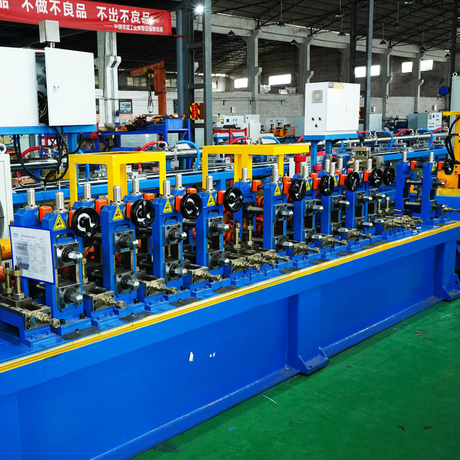
A tube mill helps you create strong tubes and pipes from metal sheets. You use a tube mill to shape and weld these sheets into metal pipes for construction and other industries. Tube mills make ERW tubes, which are common in many projects.
In 2018, factories around the world produced 109 million tonnes of tubes and pipes using tube mills.
China made 30 million tonnes.
Exports reached 45 million tonnes that year.
Key Takeaways
Tube mills make strong metal tubes and pipes from steel sheets. These tubes are important for building and car making. The process has steps like uncoiling, shGas & Oilng, welding, and cutting. These steps help tubes fit exact size and quality rules. Electric Resistance Welding (ERW) is a quick and good way to join metal in tube mills. It makes strong seams and does not waste much metal. Quality control checks, like watching the process in real time, help find problems early. This makes sure the tubes are good for many uses. Tube mills can make many shapes and sizes of tubes. This makes them useful for many kinds of work in factories.
Tube Mill Functions
Uncoiling and Feeding
You begin by getting steel coils ready. These coils are the starting material for making tubes.
You put the coil on an uncoiler. The uncoiler unwinds the metal and sends it into the line.
The strip goes through a flattening machine. This makes sure the strip is flat for shGas & Oilng.
Sometimes, you cut and weld coil ends together. This keeps the feed going and stops breaks.
A hydraulic double cone uncoiler holds and unwinds metal coils. It gives a steady flow of material to the tube mill line.
Here is a quick look at the equipment used in this stage:
Equipment Type | Function |
Uncoiler | Unwinds metal coils for the next steps. |
Hydraulic Double Cone Uncoiler | Holds and unwinds coils, giving a steady supply to the tube mill. |
Forming Shapes
After flattening the steel strip, you move to forming. You use rolls to bend the strip into round or square shapes.
Roll forming stations shape the strip slowly.
Sensors watch the forming process.
You can change settings to keep the tube shape correct.
Roll forming helps turn big coils into exact shapes. This way, you make complex tubes with even thickness. Tube roll forming is used in construction and car making.
Welding Process
When the strip is shaped like a tube, you join the edges. Welding makes a strong seam.
You check things like strip material, weldability, and how clean the surface is.
You look at the strip edges and see if the tube mill can make a good joint.
You control the welding power to keep it steady.
High-frequency welding is fast for making tubes. Arc welding and tungsten electrode methods also make strong welds. Eddy current testing finds problems during welding. This helps you make good tubes.
Sizing and Cutting
You finish by sizing and cutting the tube to the right length.
You work to make tubes with exact sizes. Strong welds help tubes pass tough tests. You can make small, thick tubes for industries with strict rules.
Tube Mill Production Process
Material Selection
When you begin making tubes, you pick the right steel strip. You can choose hot rolled or cold rolled steel. Hot rolled steel feels rough and is good for strong, simple shapes. Cold rolled steel is smooth and stronger. It is better when you need exact tubes.
Feature | Hot Rolled Steel | Cold Rolled Steel |
Processing Temp. | High temperature | Low temperature |
Surface Quality | Rough, needs treatment | Smooth, shiny |
Hardness | Lower | Higher |
Applications | Structural parts | Precise tubes |
You also think about how strong the steel is. You check if it can fight rust and how much it costs. You want steel that is safe and lasts a long time. Picking good steel helps you make strong tubes for many jobs.
Electric Resistance Welding (ERW)
In tube mills, you use Electric Resistance Welding to join the steel strip edges. ERW is quick and makes a clean, strong seam. You run the strip through rollers and shape it into a tube. Then, you use electricity to heat and weld the edges. This works well for carbon steel and alloy steel.
Specification | Details |
Suitable Material | Carbon steel, Alloy steel |
Strip Width Range | 13mm-2261mm |
Wall Thickness | 0.2mm-22mm |
Pipe Diameter | 4mm-720mm |
Production Speed | 20-120m/min |
ERW lets you make tubes fast and with less waste. You get the same weld every time, so your tubes are high quality. Tube mills use ERW because it saves money and works well.
Quality Control
You check each tube to make sure it is good. Sensors watch the wall thickness and if the tube is straight. Machines help you fix problems right away. You look for cracks, uneven walls, or marks on the surface.
Quality Control Measure | Description |
Adaptive Wall Thickness Control | Adjusts thickness to meet specs, reduces waste. |
Real-time Monitoring | Sensors collect data for quick fixes and maintenance. |
Automated Thickness Regulation | Keeps tube size steady and safe. |
Material Uniformity Standards | Ensures tubes work well under pressure. |
Process Repeatability | Makes sure every batch is the same. |
You use these checks to find problems early and fix them. This keeps the tube mill working well. It also helps you make good tubes for buildings, cars, and energy projects.
Tip: Making tubes all the time gives you more tubes, less waiting, and saves energy compared to making them in batches.
Here is a simple way to make tubes:
Get and check steel strip coils.
Feed the steel into the tube mill.
Gather material for a steady flow.
Shape the strip into a tube.
Weld the edges with ERW.
Cut the tube to size.
Stack tubes for checking.
You follow these steps to make sure every tube is right.
Welded Roll Forming System Overview
A welded roll forming system is a key part of welded tube mills. You use this system to shape and join metal strips into strong tubes. The welded roll forming system helps you make tubes quickly, safely, and with less waste.
System Components
You will find several important parts in a welded roll forming system. The system starts with a breakdown section. Here, you begin to shape the flat metal strip. Next, the strip moves to the fin-pass section. This part is very important because it shapes the material just before welding. If you want to make nonround tubes, the welded roll forming system lets you shape the material before welding. This is called near-net-shape forming. After welding, you use at least two more passes to make sure the tube has the right size and shape.
Tip: When you keep your rolling mills in good condition, you get tubes with strong welds and the right size every time.
Advantages of Welded Roll Forming
The welded roll forming system gives you many benefits. You can match the speed of welded tube mills, so you make more tubes in less time. You can also use different tools to make many shapes and sizes. This makes the system flexible for your needs.
Here are some ways the welded roll forming system helps you:
You get high efficiency because the system works fast and does not need much manual work.
You can change tools quickly, so you do not waste time when you switch products.
You keep your tubes strong and the same size by using good process control and regular checks.
You reduce waste because the system shapes and welds the metal with great care.
Improvement Area | Description |
Integrated Engineering Solutions | You save time and reduce waste from start to finish. |
Advanced Welding Technology | You get strong welds and less scrap with high-frequency welders. |
Automation and Quick Changeover | You lower labor costs and make fewer mistakes with automated systems. |
Process Optimization and Control | You keep the line running smoothly and fix problems right away. |
Reduced Material Waste | You spot defects early and avoid making bad tubes for a long time. |
Safety is also a big part of the welded roll forming system. You use emergency stop buttons, safety guards, and light curtains to keep everyone safe. The system also has overload protection and pressure relief valves. These features help you avoid accidents and keep your equipment working well.
Safety Feature | Description |
Emergency Stop Buttons | You can stop the machine right away if there is a problem. |
Safety Guards | These keep you from touching moving parts. |
Light Curtains | The machine stops if you break the light beam. |
Overload Protection Devices | The system shuts down if it gets too much load. |
Pressure Relief Valves | These release extra pressure to prevent damage. |
Lockout/Tagout Systems | You make sure the machine is off during repairs. |
Fire Detection Systems | The system finds and puts out fires quickly. |
Safety Interlocks | The system only works in the right order to keep you safe. |
When you use a welded roll forming system, you get a process that is fast, flexible, and safe. This system helps you make high-quality tubes for many uses.
Tube Mill Applications
Construction Industry
Tube mill products are used a lot in building. Metal pipes from tube mills help make buildings strong and safe. These pipes are used for many things:
Structural framework holds up beams and columns in buildings.
Scaffolding and safety rails protect workers during building work.
Plumbing and HVAC systems use metal pipes for water, heat, and air.
Electrical conduits keep wires safe from harm.
Fencing and security use strong pipes for gates and borders.
Tube mills also make hollow structural sections, called HSS. You start with flat steel plates and shape them into round tubes. After welding, you can make square or rectangle HSS. This way, you meet strict building rules and get many sizes for different jobs.
Tip: Hollow structural sections from tube mills give strong support but are lighter, so buildings are safer and use less material.
Automotive Sector
Tube mills help make parts for cars and trucks. Metal pipes from tube mills are used to make many car parts:
Brake lines carry fluid safely in cars.
Axels and drive shafts use strong welded tubes.
Chassis frames need tough pipes for support.
Roll cages and shafts use cold drawn seamless tubes for a good fit and smooth look.
Hydraulic dampeners and shock absorbers use drawn-over-mandrel tubes.
Tube mills use advanced cutting tools to help you. Flying cold saws and special blades make light and exact parts. High-speed steel or carbide blades give clean cuts, so metal pipes in cars are strong and good quality.
Feature | Benefit | Impact on Automotive Industry |
Flying cold saws | Less tool damage | Car parts last longer |
Programmable saw blades | Custom cutting settings | Parts are light and fit well |
High-speed steel blades | Clean, exact cuts | Pipes are stronger and better quality |
Energy and Infrastructure
Tube mills are important for energy and big projects. Metal pipes from tube mills are used for oil and gas pipelines, water lines, and underground utilities. These pipes do not rust easily and can handle high pressure, which is important for oil and chemical jobs.
Application Area | Description | Importance |
Oil and Gas Pipelines | Build strong pipes for moving energy | Needed for supply |
Structural Components | Make parts for bridges and buildings | Needed for strength |
Underground Utilities | Use pipes for water and power lines | Reliable and last a long time |
Tube mills help you work faster and waste less material. You make pipes with good welds every time. Quick changes let you make new pipes fast, and good controls make sure each pipe fits its job.
Tube Mill vs. Similar Equipment
Tube Mill vs. Pipe Mill
You may think a tube mill and a pipe mill are the same. They both help you make metal tubes, but they work differently. They are also used in different industries. The table below shows how they are not the same:
Aspect | Tube Mill | Pipe Mill |
Primary Function | Manufactures welded pipes | Grinds materials into fine powder |
Operating Principle | Forms pipes from steel strips | Crushes materials using balls |
Applications | Construction, automotive, infrastructure | Mineral processing, ceramics, chemicals |
Production Capacity | High-volume production | Suitable for batch processing |
Precision | Ensures uniform pipe dimensions | Provides fine particle size control |
Energy Efficiency | Efficient for continuous production | Efficient for grinding hard materials |
Maintenance | Regular upkeep required | Requires periodic inspection and maintenance |
Cost Consideration | Initial setup costs can be higher | Lower initial setup costs |
Environmental Impact | Generates less dust and noise | Requires dust control measures |
Note: You use a tube mill to make pipes and tubes for buildings and cars. A pipe mill is not for making pipes. It is used to grind materials into powder.
Tube Mill vs. Roll Forming Machine
You might see a forming machine in some factories. A tube mill makes closed tubes by forming, welding, and sizing steel strips. You can get round, square, or rectangle tubes this way. A forming machine bends metal strips into shapes like channels or angles. You do not always need welding with a forming machine. This makes the forming machine better for open shapes. The tube mill is best for strong, closed tubes.
Tip: Pick a tube mill if you need welded tubes. If you want open shapes or channels, use a forming machine.
You use a tube mill to make strong tubes. These tubes are used in many industries. Tube mills help you work fast and use less material. You can trust tube mills to make good pipes for buildings, cars, and energy jobs. If you want tubes that are always the right size, use a tube mill.
Make tubes fast and keep workers safe
Get tubes with the right size each time
Use less metal and save more money
Tip: Tube mills help you follow tough rules for every job.
FAQ
What materials can you use in a tube mill?
You can use steel, stainless steel, aluminum, and copper. Most tube mills work best with steel strips. You pick the material based on the strength and use of the final tube.
How do you keep tubes the same size?
You use sensors and control systems. These tools check the tube size during production. You adjust the machine if you see any changes. This helps you make tubes with steady sizes.
Why do you use ERW in tube mills?
ERW, or Electric Resistance Welding, gives you strong and clean welds. You can make tubes quickly and with less waste. This method works well for many types of steel.
Can you make different tube shapes with one tube mill?
Yes, you can. You change the forming rolls and settings to make round, square, or rectangle tubes. This lets you use one machine for many jobs.